


Adieu Twitter. (2022)*

Je suis triste d’avoir supprimé mon compte Twitter. J’étais sur la plateforme depuis 2009 et j’aimais beaucoup le format. Je me sens un peu orphelin ce soir, mais l’arrivée d’Elon Musk a changé la donne. Plusieurs ont décidé de rester sur Twitter malgré la prise de contrôle, et quelques-uns ont même déclaré qu’en restant ils résistaient à l’oppresseur. De mon côté, je pense que la venue d’un tel personnage, d’un égocentrisme qui rivalise avec celui de Trump, est dangereuse. Twitter est maintenant le jouet privé d’un grand malade, et je ne veux en aucun cas m’associer à ses entreprises et encourager ses lubies. D’autre part, c’était vraiment facile et très rapide d’effacer 13 ans de gazouillis.
I am sad to have deleted my Twitter account. I have been on the platform since 2009 and liked the format. I feel orphaned tonight, but Elon Musk’s arrival changed the game. Many have decided to stay on Twitter despite the takeover. Some have cited that by staying, they are poised to participate in a kind of resistance to the oppressor. For me, the arrival of such a character, with an egocentricity that rivals Trump’s, is dangerous. Twitter is now the private plaything of a madman, and I don’t want to be associated with or encourage his whims in any way. On the other hand, it was easy and quick to erase 13 years of tweets.
Daniel H. Dugas
29 avril 2022
ABC: Art, Biodiversity and Condos (2022)
A recent article in the Toronto Star about a new mural installed in front of a luxury condo prompted me to reflect on art and biodiversity. My first reaction:

I admit I should have said celebrating instead of enhancing. I reread the article trying to make sense of it all, to remain open minded, and I tried to understand the motivations of both the artist and the developers. I cannot.
If biodiversity is the quality or state of having a large number of plant and animal species in an area, any new buildings that use that specific area, have direct impacts in terms of destruction of habitats and more subtle effects on biodiversity such as disturbance and fragmentation.[1]
There are many problems with the placement of this artwork. First, biodiversity and luxury condos don’t go hand in hand. There is a disjunction between the two even if the developers would like us to think otherwise. If biodiversity is for everyone, luxury condos are not. Moreover, there is a direct link between the loss of biodiversity and economic inequalities.[2] In other words, economic inequality predicts biodiversity loss. [3] I don’t know if a mural on the shady side of the building might remind us of flourishing biodiversity, or is it more likely a memento mori for it. Are we supposed to consider the biodiversity of Lake Ontario and its waterfront parks before or after the mural was put up?
The artist tells us that she was thinking of horizons, the way light reflects on water at different times of day and season. It’s too bad that the mural is facing the highway. The ones who have lakeside view apartments, would be more in tune to this than the ones who gaze inland. For those driving by, in the shadow of the building, it might be a wishful reminder that everything is excellent.
On the bright side, I am happy to read that the panels are recyclable, but it is a quality that remains obscure when we talk about permanent sculpture.
New condo celebrates lakefront biodiversity with 120-metre mural along the Gardiner (February 2, 2022)
[1] http://www.businessandbiodiversity.org/construction.html
[2] https://www.mcgill.ca/newsroom/channels/news/biodiversity-loss-linked-economic-inequality-worldwide-25398
[3] https://journals.plos.org/plosone/article?id=10.1371/journal.pone.0000444

February 7, 2022

February 8, 2022
La vie secrète des logos, ou Que font les logos une fois la nuit tombée ? (2021)*

La vie secrète des logos, ou Que font les logos une fois la nuit tombée ?
Les logos sont des symboles, des éléments graphiques censés représenter quelque chose, mais comment prennent-ils vie ? Comment sont-ils imaginés ? Les graphistes observent l’objet à logofier+ en apportant avec eux tout leur baggage au moment de la création. Souvent, cependant, des idées se mélangent, d’autres logos, des portions ou des parties, viennent se greffer, consciemment ou non, à la nouvelle entité. Ces objets frankensteiniens m’ont toujours fasciné.
Récemment, j’ai été frappé par la ressemblance entre les anciens logos de l’Alberta College of Art, un collège d’art basé à Calgary maintenant connu comme Alberta University of the Arts, et de l’Assomption-Vie, une entreprise de services financiers basée à Moncton. Si le logo du collège, né — m’a-t-on dit — dans les années 1960, est un frère ou une sœur du triangle de Penrose++, le logo de l’Assomption-vie, créé au milieu des années soixante-dix, est sans doute l’un de ses cousins. Il est aussi un descendant du logo Woolmark de 1964, créé pour l’International Wool Textile Organization.
Daniel H. Dugas
5 mai 2021
+ Logofier suit la même construction que « liquéfier ».
++ Le triangle de Penrose est une invention du mathématicien Roger Penrose dans les années 1950 et représente un objet impossible.
The secret life of logos, or What do logos do after dark?
Logos are symbols or graphics meant to represent something, but how do they come to life? How are they imagined? Graphic designers look at the object to be logofy* and bring their baggage to the drawing board, but often ideas from other brands become part, knowingly or not, of the new entity. These Frankensteinian objects have always fascinated me.
Recently, I was struck by the resemblance of the old Alberta College of Art and the Assomption-Vie logos. If the ACA logo, born, I was told, in the 1960s, is a brother or sister to the Penrose Triangle, the Assomption logo, created in the mid-seventies, is certainly one of its cousins. It is also a descendant of the 1964 Woolmark Logo of the International Wool Textile Organization.
‘Logofy’ is in the same construction as ‘Liquefy’
Daniel H. Dugas
May 5, 2021
Top left: Penrose Triangle, top right: Alberta College of Art, bottom left: Woolmark Logo and bottom right: Assomption-vie.
Thanks to Marion Garden, Alberta University of the Arts, and to Charles Cousins and Don Mabie for assistance in retracing the lineage of these logos.
Chariots (2021)*
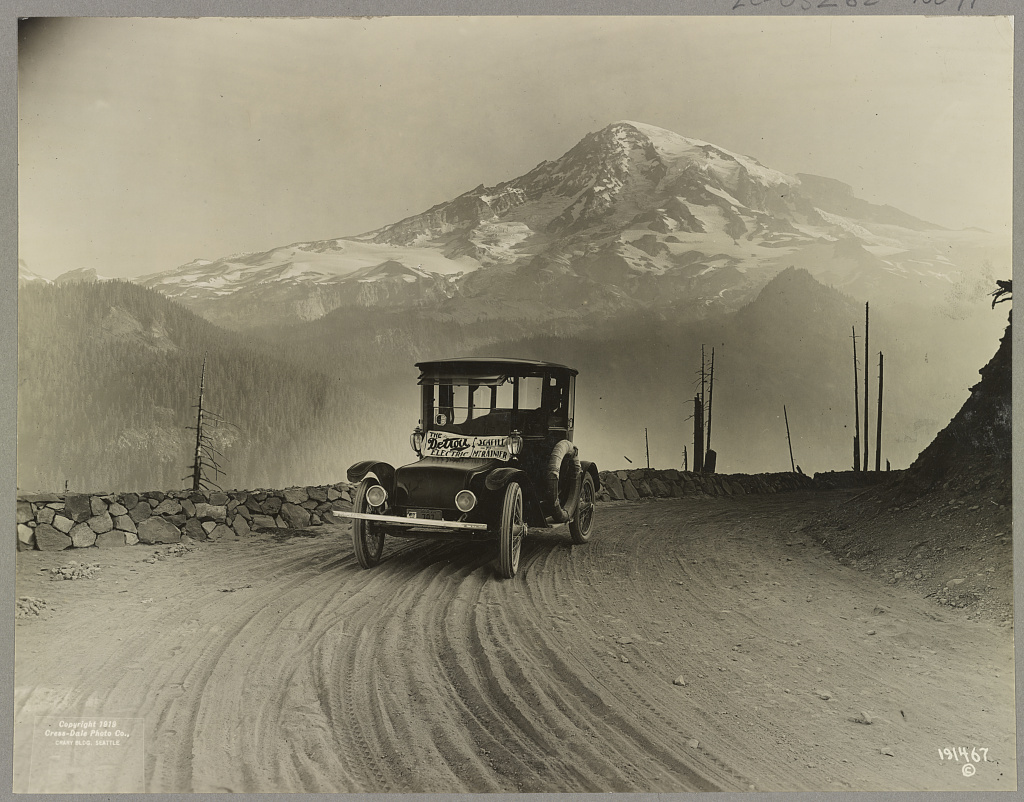
Clara Ford drove a 1914 Detroit Electric, which she far preferred to the Model T, a gasoline-engine car built by her husband, Henry. [1] Detroit Electric shipped its last car in 1939, and now we are told that the race to the electric vehicle has just started. [2]
Every carmaker plans to become carbon-neutral soon, and they are constantly telling us that the planet can only be saved by purchasing electric cars. Like anyone else, I appreciate the advantages of electric vehicles in carbon management, but we are not given the whole story. According to some, such as BHP, 125 million electric cars could be on the road by 2030. These cars will need about 183 lbs. of copper to build their motors. [3] Mining those millions of tons of copper will not be very kind to Mother Earth. Will she be saved or not?
I also have a certain ‘inquiétude’, a worry that our planet can only be saved by those with money to promote mining. How can the poor help? How can Earth be truly saved if we exclude those who are economically challenged? Is it not ‘our’ planet after all? How can the electric car be a symbol of both salvation and inequity? If there were a heartfelt desire to save Mother Earth, governments would give tax breaks to those who have forfeited car ownership, instead of helping others to buy more vehicles.
What is killing the world is the societal model that promotes constant and excessive consumption. The rest is marketing, and so far, marketing has not saved anything.
Clara Ford conduisait une Detroit Electric de 1914, qu’elle préférait de loin à la Model T, une voiture à moteur à essence construite par son mari, Henry. [1] Detroit Electric a fabriqué 13 000 voitures électriques de 1907 à 1939 avant de fermer ses portes cette année-là, et maintenant, on nous dit que la course aux véhicules électriques ne fait que commencer. [2]
Chaque constructeur automobile prévoit devenir carboneutre bientôt, et ces entreprises nous répètent sans cesse que la planète ne peut être sauvée qu’en achetant des voitures électriques. Comme tout le monde, je reconnais les avantages des véhicules électriques en matière de gestion du carbone, mais on ne nous raconte pas toute l’histoire. Selon certains, comme BHP, 125 millions de voitures électriques pourraient circuler sur les routes d’ici 2030. Chaque voiture nécessitera environ 183 livres de cuivre pour fabriquer son moteur. [3] Le processus d’extraction implique une forte consommation d’énergie, des émissions de gaz à effet de serre et un risque de pollution de l’eau et de l’air. Il est évident que l’extraction de millions de tonnes de ce minerai laissera des marques sur la planète.
Je m’inquiète également que la Terre ne puisse être sauvée que par ceux qui ont les moyens de promouvoir l’exploitation minière et que les plus démunis soient sans recours. Comment la Terre peut-elle vraiment être sauvée si l’on exclut ceux qui sont en difficulté économique ? N’est-ce pas « notre » planète, après tout ? Comment la voiture électrique peut-elle être à la fois un symbole de salut et d’injustice ? Ne vaudrait-il pas mieux que les gouvernements offrent des crédits d’impôt à ceux qui ont renoncé à posséder une voiture, au lieu d’aider les autres à en acheter davantage.
Ce qui tue notre monde, c’est le modèle de société qui encourage la consommation constante et excessive. Le reste, c’est du marketing — et jusqu’à maintenant, le marketing n’a rien sauvé.
Daniel H. Dugas
February 23, 2021
Image credit: [Detroit Electric auto on a promotional tour through mountains from Seattle to Mt. Rainier] / Cress-Dale Photo Co., Crary Bldg, Seattle. https://www.loc.gov/item/2003653829/
For more on this:
A Clear Conscience and a Bright Blue Sky (2020)
http://daniel.basicbruegel.ca/a-clear-conscience-and-a-bright-blue-sky-2020/
[1] Henry Ford’s Wife Wouldn’t Drive Ford Model T, Kept Her Electric Car
https://cleantechnica.com/2014/04/11/henry-fords-wife-wouldnt-drive-model-t-kept-electric-car/
[2] Our Path to an All-Electric Future
https://www.gm.com/electric-vehicles.html
[3] How Much Copper is in an Electric Vehicle?
https://www.visualcapitalist.com/how-much-copper-is-in-an-electric-vehicle/
A Clear Conscience and a Bright Blue Sky (2020)*
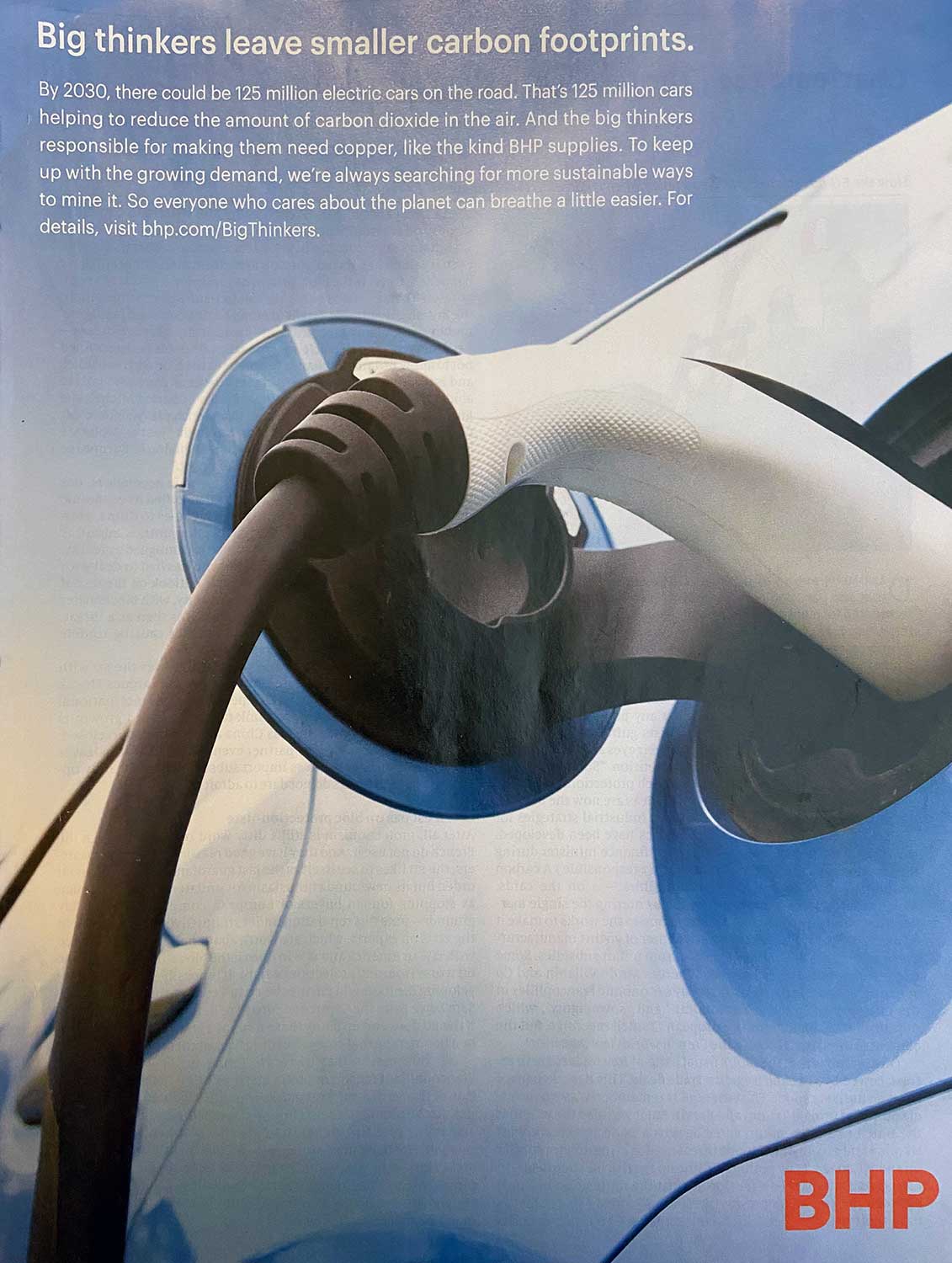
The goal of any ad is to make us feel good about a company and its products. This ad from the Melbourne, Australia-based BHP Billiton multinational mining, metals, and petroleum company fits the bill. According to its advertorial message, published in The Economist in October 2020, electric cars will save the world by reducing the amount of carbon dioxide in the air. But this glossy hope does not tell the whole truth. The ad states, “By 2030, there could be 125 million electric cars on the road.” More vehicles on the roads are supposedly the hope for our future, and these are the words of a company responsible for so much destruction.
Still fresh on our environmental awareness radar is the 2015 collapse of a dam at the Samarco-BHP mine. This was Brazil’s most significant ecological disaster; it killed 19 people and spilled roughly 40 million cubic metres of toxic sludge into communities, the Rio Doce river, and the Atlantic Ocean, 650 km away[1].
BHP Billiton is also responsible for the Ok Tedi environmental disaster in Papua New Guinea. Between 1984 and 2013, BHP’s mine discharged about two billion tonnes of untreated mining waste into the Ok Tedi River [2]. This is the same company that has violated scores of indigenous communities’ rights across the Americas.
The trail of environmental, social, and public health disasters linked to BHP[3] is a long one, and yet they want us to think of them as the saviour of the world; they want us to believe that they are the “Big Thinkers” who leave a small carbon footprint. It is hard to take and even harder to understand why such ads could be printed.
One hundred and twenty-five million electric cars will not solve the problems of pollution that arise through their manufacturing process; the extraction of tonnes and tonnes of copper needed to build the hearts and the veins of these cars will not make our planet better. The only ones to profit are the investors and perhaps the marketers selling us on the fallacy that our conscience should be clear.[4]
Une conscience tranquille et un ciel bleu éclatant (2020)*
Le but de toute publicité est de nous faire ressentir du positif envers une entreprise et ses produits. Cette publicité de BHP Billiton, une multinationale minière, métallurgique et pétrolière basée à Melbourne, en Australie, remplit parfaitement ce rôle. Selon son message publicitaire, publié dans The Economist en octobre 2020, les voitures électriques sauveront le monde en réduisant la quantité de dioxyde de carbone dans l’air. Mais cet optimisme sans borne ne dit pas toute la vérité. La publicité affirme : « D’ici 2030, il pourrait y avoir 125 millions de voitures électriques sur les routes. » Voilà un énoncé plutôt fracassant pour une entreprise responsable d’une panoplie de désastres industriels. Si davantage de véhicules sur les routes représentent l’espoir de notre avenir, nous voilà le pied au plancher au milieu du trafic de l’heure de pointe de l’humanité.
Encore bien présent dans notre conscience environnementale est l’effondrement, en 2015, d’un barrage de la mine Samarco-BHP. Il s’agit du plus important désastre écologique qu’ait connu le Brésil : 19 personnes y ont perdu la vie et environ 40 millions de mètres cubes de boues toxiques ont été déversés dans les communautés avoisinantes, dans le fleuve Rio Doce, et jusque dans l’océan Atlantique, à 650 km de là [1].
BHP Billiton est également responsable de la catastrophe environnementale d’Ok Tedi, en Papouasie-Nouvelle-Guinée. Entre 1984 et 2013, la mine de BHP a rejeté environ deux milliards de tonnes de déchets miniers non traités dans la rivière Ok Tedi[2]. C’est la même entreprise qui a bafoué les droits de dizaines de communautés autochtones à travers les Amériques.
La liste des désastres environnementaux, sociaux et sanitaires liés à BHP [3] est longue, et pourtant, cette illustre entreprise veut nous faire croire qu’elle sauvera le monde ; que nous sommes peut-être comme elle, de « grands penseurs » qui laissent une toute petite empreinte carbone derrière nous !
Cent vingt-cinq millions de voitures électriques ne régleront pas les problèmes de pollution qui naissent de leur processus de fabrication ; l’extraction de millions de tonnes de cuivre nécessaires à la fabrication de ces voitures ne rendra pas notre planète plus saine, au contraire. Les seuls à en tirer profit seront les investisseurs et peut-être les spécialistes du marketing qui nous vendent cette illusion d’une conscience tranquille [4].
[1] BHP faces first step in $6.3 billion UK claim over Brazil dam failure
[2] Ok Tedi environmental disaster
[3] Broken Hills: Six cases from BHP’s long trail of disasters (PDF)
[4] According to the Visual Capitalist website, an EV contains about 183 lbs. of copper. 125 millions cars multiplied by 183 lbs. equal twenty three billion pounds of cooper.
From ‘Liberated Words’ (2020)
Re: Videopoetry / Vidéopoésie Interview with Catherine Parayre.
Sarah Tremlett posted the following text on the Liberated Words website:
BY SARAH TREMLETT · PUBLISHED OCTOBER 8, 2020
http://liberatedwords.com/2020/10/08/videopoetry-videopoesie-interview-with-catherine-parayre-2020/
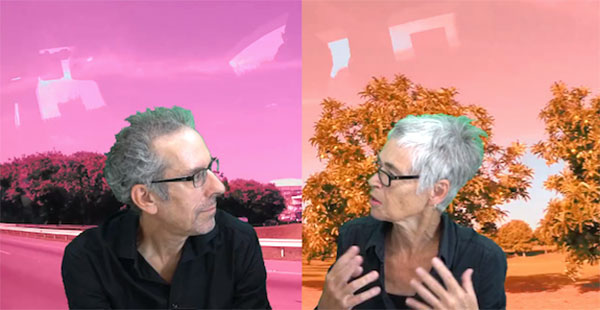
A while ago I mentioned the launch of the must-have publication on videopoetry ¬¬– Videopoetry / Videopoésie by pioneer Canadian practitioners Daniel H. Dugas and Valerie LeBlanc (Basic Bruegel). Valerie and Daniel have now conducted a really delightful, succinct and revealing interview see https://vimeo.com/447315272 with Catherine Parayre, editor at the book’s publishing house The Small Walker Press, Brock University, Ontario.
I am of course not impartial to their work since I was fortunate enough to be invited to write an essay for the book. In doing so I was able to excavate pure gold in terms of the history of videopoetry. This relatively short interview gives a glimpse into their world and how they work together. There are also some clever green screen projections and visually playful (I love the captioned birds behind them!) videos, which seem to have their own voice, almost stealing the thunder from their makers.
Some nuggets include their views on collaboration or shared vision: ‘when we witness the same events … reprocessing what we are seeing in different ways’; and their understanding of the term ‘videopoetry’ as opposed to referencing film, even though ‘the two are permeable today’. For them, they have always used video cameras (changing format across the decades) and worked with video as an accessible medium unlike film. Ultimately Daniel says he likes the term ‘video’ which comes from the Latin videre ‘to see’.
Catherine made a very poignant point about their video images; that though captured in a book, they seem to contain movement, as opposed to the still photograph. She emphasized that they weren’t ‘quite stable’. Daniel pointed out that often they were using older technology; or low grade consumer equipment that creates a ‘ghost’. But I feel there was more to that point, and I have noted how they work with time over and over again in their practice. This sense of passing through with video; the temporal philosophical estrangement of the moment, can become a rich metanarrative in the right hands. For Valerie and Daniel, time falters but does not stop.
Becoming Purse (2020)*

A kid with a kite stands on the edge of a cliff. We cannot see his or her face; the natural lighting of the scene draws the figure like an iPod silhouette, anonymous and universal. There is something fundamental about the image, like a snapshot taken during an outing; it could be your kid, my kid. The purple colour in the sky and the yellowish glow at the horizon point to a sunrise on the East coast or a sunset on the West coast. This is for anyone, anywhere, with leisure time. It might even be an ode to the heroic Homan Walsh, the youth who flew his kite high above the gorge of Niagara Falls in 1848. As a result, he secured a line that was used to start the construction of the suspension bridge. At the bottom of this image, there is the caption ‘Imagination takes flight’.
But the reverie is interrupted when the physical intricacies kick in. If a cliff can provide ample wind, it might also be a dangerous place to hang out in the dark, whether early in the morning or late in the evening. But falling is not the only hazard; another danger lurks behind the child’s knees. We are not sure if it is a line, a rod, or part of the ribbon of the kite. Will the kid trip and tumble down the precipice? We hope not, but we don’t know. Maybe the kid falls onto the rocks below, but ultimately, the flying kite saves them? Maybe.
‘Go fly a kite’ is a phrase that tells someone to ‘get lost’. The kid seems to be alone, but someone took the picture, so that is not true. ‘As high as a kite’ is an expression used to indicate that someone is extremely intoxicated. Although a video would be a better way to gauge the situation, there is no evidence that the kid or the photographer is high. Louis Vuitton is inviting us to be part of a kite experiment, but we are not yet sure what the circumstances of this flight of imagination might be.
A kite needs a tail to keep it from spinning and rolling around. The one in the picture has a long tail and will probably be stable. In French, the word tail (queue) has the same meaning as the English word, but it can also mean a penis. To me, the small protruding part on the left side of the ribbon looks like the French descriptor. And if we take the bottom section of the tail (which looks like a ‘skydancer’ or ‘tube man’ and is about the same height as the kid) and move it to the right, juxtaposing it onto the child, we can see an appendage appear: the kid becomes a man!
And then another symbol gets in the way: two crosses floating in mid-air. What are they? The first is part of the kite’s frame; the second, made of ribbon, floats above and is out of focus. The latter takes the appearance of a double helix. The kid is a believer, a man of science now dabbling in molecular biology!
We don’t know what kind of kite experiment is at play here. Is it a religious or a biological quest, or just family fun searching for the perfect ‘sacoche’? How this image of a kid becoming man, and a kite with religious undertones, might make us feel about a leather purse is anyone’s guess. The imagination can only hover so long above the abyss of the dreamed object. If a heavy purse makes the heart light, it can also weigh down the kite.


The value of ours lives (2020)*
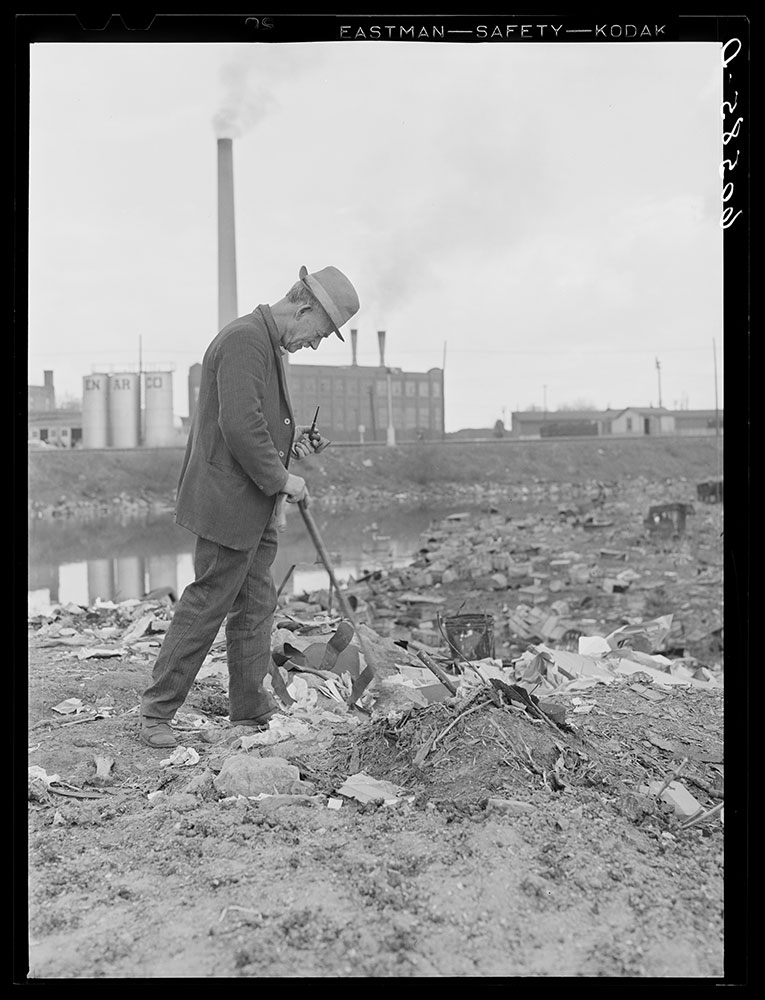
The Covid-19 pandemic has given us a chance to see what our leaders think of the value of our lives. If this isn’t cool, it’s at least interesting.
Yes, life is complicated, and we know it’s priceless. Nevertheless, there are methods to assess the value of a life, which is also a difficult thing to do. Different economists will arrive at other results. It all depends on the angle they choose. Two basic and often quoted methods to monetize and estimate the value of life are the VSL (value of a statistical life) and the QALY (quality-adjusted life year). In the U.S., the Office of Management and Budget puts the value of human life in the range of $7 to $9 million. We can assume that the numbers in Canada are close to those of the US. As we also know how much money governments have thrown at the coronavirus crisis so far, we should be able to calculate how far our societies will go to preserve life or decide to let some go.
The whole situation is a conundrum at best or a Hobson’s Choice at worst: we live next to a factory that spews toxins over our communities, but that is where we work.
Daniel H. Dugas
May 9, 2020
See also: The Cost of a Human Life, Statistically Speaking
Photo, Library of Congress: Residents of shack town making daily round through the city dump looking for anything of value. Dubuque, Iowa | Vachon, John, 1914-1975, photographer
Your Life Is Worth $10 Million, According To The Government
NPR, July 17, 20208:01 AM ET
https://www.npr.org/sections/money/2020/07/17/870483369/your-life-is-worth-10-million-according-to-the-government
Videopoetry / Vidéopoésie announcement Liberated Words (2020)
Videopoetry = Vidéopoésie
BY · PUBLISHED · UPDATED
Wonderful news that the mammoth – over 400 pages – publication Videopoetry = Vidéopoésie by leading Canadian videopoets Valerie LeBlanc and Daniel H. Dugas is now out online https://dr.library.brocku.ca/handle/10464/14790
Published by Brock University’s Small Walker Press it is a comprehensive survey of their collaboration over a thirty-year period. Catherine Parayre has written the French introduction, with Lucy English writing in English. It has also been my pleasure to contribute an essay on their extraordinary body of work. In my research it took me a long time to get to know (and relish) all their developments. I am particularly fond of their use of documenting first-hand experience as in ‘Slices of Life’ from the nineties for example; as well as their finely crafted and important ecopoetry films of more recent years. For my in-depth analysis on their filmic and poetic techniques please check out the book itself.
But I would just like to say that what adds to the poetry (that is always succinct, and of its time and place whilst setting us on a philosophical path), is the fact that it is bilingual. This can create comparisons (visual as well as verbal), as one language is typeset next to the other, but also reminds us of their Canadian roots, and all its associations and influences (geographic, artistic and political). The poetry and the videos emanate not just from the combining of two creative fields, and the collaboration and consequent creative marriage of two people, but two significant cultures. This ‘bilinguality’ extends our understanding of what it means to be not just poetically engaged and enlightened but politically aware in the 21st century. Go Read!!!!
Starboard (2019)*

Keywords: ecocide, whales, society, conscience
The Japanese Government lifts the whaling ban and kills two on the first day. That is the headline we all woke up to hear. For me, it was like reading that we were at war, that an earthquake had struck, or that a bomb had exploded.
How can we consciously decide to go out and slaughter the few whales that are left in the oceans? And for what? How can we do this after being exposed to all the awareness campaigns of the last 30 years? After having seen all of the whale movies? Was it all just entertainment, good old fun? Today, our conscience is more akin to bling, something we wear if it matches the rest of our outfit. It seems that we are incapable of becoming aware of any moral principles, incapable of being motivated to act upon them and cannot assess our character, behaviour, and ultimately ourselves against those principles. [1] We are the spect-actors of a horrible spectacle, but we still enjoy the drama.
Everything that we have seen and everything that we have believed in is as useless as the trash blowing on a street. Worse, we throw the refuse out of the car windows while driving on a scenic route. I am ashamed to be part of it. Yes, I am part of it; we all are. At this moment, we are putting on our raincoats and sharpening our harpoons. We are leaving our homes under the cheers of our friends and families. We are going to bring back as many whales as we can. The world has made us monsters roaming the seas; death is our trophy.
And right here, at the antipode of these Japanese killing fields, in our own Gulf of St. Lawrence, scores of whales wash onshore, entangled, hit, rotting. At first, we see a stand from the government imposing a speed limit on vessels in the Gulf. It didn’t take long to hear protests from the shipping, the cruise lines, and the fishing industries. Our vacations, our consumption, and our infinite appetite for seafood are what count here. It is all complicated, they say. For our economy, etc. It has come down to this: to us, wanting things and not giving a damn about anything else. Payments on a fully loaded F-150 have more value than saving a whale. And our subsequent collective silence is a collective nod to kill the last of every living thing. We are like those directly involved, putting on raincoats and sharpening harpoons.
When the last whale alive is near the end of its life, entrepreneurs will surely seize the opportunity to create an event where seats will be sold and snacks will be served. The chosen few will witness the extinction of that great animal. It will become a handle, a hashtag, an image on Instagram as it vanishes from our world.
The sea is rough, and my shame and sadness have no weight to hold it back. I am on a dinghy, struggling to float beside the larger ships of our modern life.
P.S. A few years ago, the International Criminal Court was considering adding Ecocide to its list of punishable crimes [2]. I am sure that whaling falls into this category.
Daniel H. Dugas
July 9, 2029
[1] Conscience, paraphrased from the Stanford Encyclopedia of Philosophy, Mar 14, 2016
https://plato.stanford.edu/entries/conscience/
[2] Proposed amendment to the Rome Statute, Eradicating Ecocide
https://eradicatingecocide.com/the-law/what-is-ecocide/
Image: Cutting up a blue whale | Library of Congress https://www.loc.gov/item/99614373/
Archives
Blogroll
- A.I.R. Vallauris
- ACAD
- Adobe additional services
- Adobe Creative Cloud
- AIRIE
- Amaas
- Amazon Author Central
- ARTothèque
- Australian Poetry
- Basic Bruegel
- Bitly
- CCCA
- CDBaby
- Cycling 74
- Dissolution
- Éditions Prise de parole
- Emmedia
- eyelevelgallery
- FAVA
- Festival acadien de poésie
- Festival FRYE Festival
- FILE – Electronic Language International Festival
- Freeware list
- Fringe Online
- Galerie Sans Nom
- Gotta Minute Film Festival
- Instants Vidéo
- JUiCYHEADS
- Kindle Direct Publishing
- Klondike Institute of Art and Culture
- La Maison de la poésie de Montréal
- La Maison de la Poésie et de la Langue française Wallonie-Bruxelles
- Laboratorio Arte-Alameda
- Le Centre Jacques Cartier
- Liberated Words
- Maison Internationale de la Poésie – Arthur Haulot
- MediaPackBoard
- Miami Book Fair International
- Monoskop
- Mot Dit
- NSCAD University
- Paved Arts
- PoetryFilm
- Portail des auteurs du Nouveau-Brunswick
- RECF
- Revue Ancrages
- Salon du Livre du Grand Sudbury
- Sculpture Space
- Subtropics.org
- Sydney college for the arts
- The Centre for Contemporary Canadian Art
- The New Gallery
- Trevigliopoesia
- tumbler-documents
- V Tape
- Valerie LeBlanc
- VideoBardo
- Void Network-Κενο Δίκτυο
Categories
- #covidpoèmes
- Advertisement
- AIRIE
- Ancrages
- anthology
- Anthropocene
- Architecture
- Around Osprey
- art
- Article de presse
- arts visuels
- audio
- Australian Poetry
- Basic Bruegel Editions
- Book
- book fair
- Cafe Poet Program
- Ce qu'on emporte avec nous
- Citations gratuites
- Collaboration
- commentaire
- commentary
- Compte rendu
- conférence
- Conservation Foundation of the Gulf Coast
- COVID-19
- Critique littéraire
- culture
- Daniel Dugas
- Design
- Édition Michel-Henri
- Éditions Perce-Neige
- Éloizes
- Emmedia
- emoji etc | émoji etc
- Environnement
- essai
- essay
- Everglades
- Exhibition
- festival
- Festival acadien de poésie
- Festival Frye Festival
- FIPTR
- Flow: Big Waters
- Fundy
- Habitat
- installation
- Instants Vidéo
- interactivity
- journal
- JUiCYHEADS
- Kisii
- L'Esprit du temps
- laptop
- Leaving São Paulo
- lecture
- Livre
- logos
- Magazine
- Miami Book Fair
- Moncton 24
- novel
- OASIS
- oil spill
- perception
- performance
- Photo
- poésie
- Poetic Licence Week
- Poetry
- politics
- politique
- press
- Prise de parole
- Revue Ancrages
- salon du livre
- sculpture
- Sculpture Space
- sound
- Souvenirs
- Spirit of the Time
- Style & Artifacts
- Symposium d'art/nature
- talk
- television
- The New Gallery
- Uncategorized
- Valerie LeBlanc
- vidéo
- vidéopoésie
- Videopoetr/Vidéopoésie
- videopoetry
- visual arts
- What We Take With Us
- youth literature
